Guides
Lawn mowing price per square metre Canada: rate guide
Lawn mowing price per square metre Canada varies with lot size. See rate bands, cost drivers, a minimum visit charge, and an illustrative weekly quote.
What to take away
- The lawn mowing price per square metre Canada customers see is usually quoted as a flat visit rate, not a measured-area charge.
- Rate bands vary by lot sizeunder 500 square metres, $0.10 to $0.25; 500 to 800 square metres, $0.06 to $0.14; rural lots of 4,000 square metres and up, $0.004 to $0.008.
- Labour is the largest line on the invoice, and provincial minimum wage sets the floor under it.
- A 500 square metre urban lot and a 2,000 square metre rural lot rarely share the same rate per square metre.
- Quotes that name only a per-visit price hide travel, trimming and disposal.
What the range covers
The figures here use Canadian dollars per square metre. They are broad lot-size bands rather than province- or city-specific quotes; travel, lot layout and minimum visit charges can change the price an operator needs to set.
A suburban lot of 500 to 800 square metres of actual turf, mowed every week from May to September, typically bills at $45 to $70 a visit. Divide that out and you get roughly $0.06 to $0.14 per square metre for small properties, because the fixed cost of showing up is spread over very little grass.
Typical rate bands by lot size:
| Lot size (turf) | Typical rate per square metre |
|---|---|
| Under 500 square metres | $0.10 to $0.25 |
| 500 to 800 square metres | $0.06 to $0.14 |
| 800 to 2,000 square metres | $0.03 to $0.08 |
| 4,000 square metres and up | $0.004 to $0.008 |
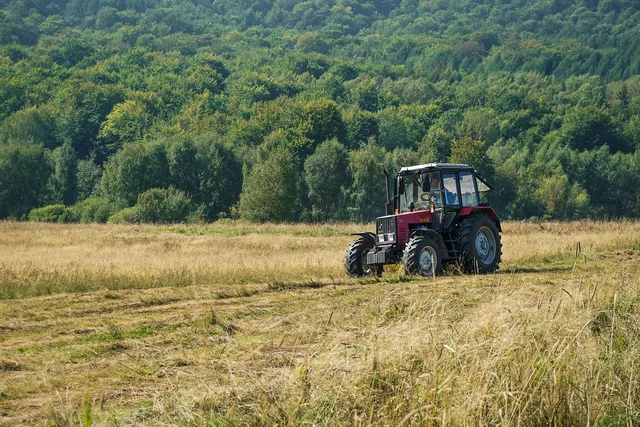
Large rural properties of 4,000 square metres and up often price at $0.004 to $0.008 per square metre, since a ride-on mower covers ground fast and the crew is not resetting a trimmer every ten minutes. The table below shows where the money sits on a typical invoice.
Line item / Share of invoice
- Labour, including statutory costs
- 45 to 60 percent
- Equipment, finance and fuel
- 15 to 25 percent
- Travel between stops
- 10 to 20 percent
- Disposal and admin
- 5 to 10 percent
These shares are typical bands, not fixed rules, and they shift with route density.
What each cost line looks like
Entry-level staff are usually hired near the provincial minimum wage, and every increase lifts the whole wage band above it. Ontario's general minimum wage was $17.60 an hour as of October 1, 2025, and Alberta's held at $15.00 as of October 1, 2018.
A two-person crew at $20 an hour each, plus statutory costs, is close to $50 an hour before the truck moves.
Equipment and fuel are the second line. A commercial mower financed over three years, blades, oil, filters and fuel add up to a real hourly cost that many quotes never separate out. Grass growth rates also drive how often you return, and cool-season species such as perennial ryegrass push a weekly schedule in late spring.
Travel is the line that decides whether a route is profitable. Fifteen minutes of driving between stops, four times a day, is an hour of unpaid production. Grouping jobs by neighbourhood reduces unpaid drive time and makes a route easier to price.
Disposal and admin cover dumping fees, software, insurance and the time spent quoting. Small but persistent.
What moves the number
- Provincial minimum wage. Wage floors vary by province and affect the labour cost in a quote. Check your province's current rate before building a rate card.
- Lot shape and obstacles. A rectangular lawn of 800 square metres mows faster than a treed 800 square metres with beds, fences and a shed. Obstacles can add 30 to 50 percent to visit time.
- Mowing frequency. Weekly service is cheaper per visit than biweekly, because the grass is shorter and you are not double-cutting. Frequency also affects turf health, as lawn care explains.
- Season length. A shorter growing season concentrates revenue into fewer months, so each visit has to carry more overhead.
A rate that works in the Fraser Valley may fail in Saskatoon, not because the grass is different but because the working season is shorter.
What moves the price
- 30 to 50%added visit time from obstacles
- Weeklycheaper per visit than biweekly
- Provincial minimum wagesets the wage floor
- Season lengthconcentrates overhead into fewer months
What quotes leave out
Most quotes state a per-visit price and stop. They rarely mention the minimum visit charge, which protects you on tiny urban lots where the drive costs more than the mow. A typical Canadian minimum is $45 to $55 a visit, so a small lot never sells below that floor.
They rarely state what happens when rain pushes a visit, or whether trimming, blowing and edging are included.
They also leave out the contract term. A handshake weekly arrangement and a signed seasonal contract carry different risk, and contract law basics are worth understanding before you promise a fixed rate for six months. Building the quote itself is covered in From enquiry to quote in a lawn care business: template and pricing.
Where people overspend
New operators overspend on equipment first. A loaded commercial mower bought before the route exists sits idle and eats margin. Fuel and finance costs are real whether the machine runs or not.
They also overspend on underpricing. Quoting $40 a visit for a 900 square metre lot to win the job leaves nothing for a wage increase in July. The correction is a written rate card with a floor, reviewed each spring before the season starts.
- Rate card states a per-square-metre rate and a minimum visit charge
- Labour cost calculated at your province's current minimum wage and above
- Travel time built into the price, not absorbed
- Trimming, blowing and disposal listed as included or extra